

You’ve been in Bali for what, eight months now? Maybe a year? You’ve watched the same crew of remote workers cycle through Canggu, lease the same overpriced studios in Berawa, and complain about the same traffic on Jalan Pantai Pererenan. And at some point, sitting at a co-working space watching another villa go up across the street, the thought hits: why am I renting? Could I actually buy something here?
Short answer: yes, you can. But not in the way you’d buy land back home, and definitely not the way the WhatsApp groups make it sound. There’s a lot of bad information floating around about foreigners buying property in Bali, and a lot of it could cost you real money.
So let’s walk through what’s actually possible in 2026, what the rules really say, and what a digital nomad on a remote-worker KITAS or a Second Home Visa can realistically do.
First, the Rule You Can’t Get Around
image by Bali Exception
Path 1: Leasehold (Hak Sewa) — The Digital Nomad Default
This is what 75 to 80 per cent of foreign buyers in Bali use, and for good reason. Leasehold is straightforward, it doesn’t require a residency permit, and it doesn’t have a minimum price threshold.

Here’s how it works: you sign a long-term lease with the Indonesian landowner, typically 25 years initially, with a contractual right to extend for another 20 or 25 years. The lease is notarised through a PPAT (a state-authorised land deed official), and during the lease term you can build on the land, live on it, rent it out, sell the lease to someone else, and basically treat it as yours within the terms of the agreement.
Table of Contents (Daftar Isi)
What You Need

Yoexplore- Digital Nomad
- No KITAS, no KITAP, no Second Home Visa required.
- You can do this on a tourist visa, a B211A social visa, or an E33G Remote Worker KITAS.
- No minimum property value.
- An independent notary, and ideally an independent lawyer to review the lease deed before you sign.

What You Give Up
- Your right is contractual, not a registered title at BPN, the National Land Agency. That means the quality of the lease agreement and the integrity of the landowner matter enormously.
- At the end of the lease term, the land reverts to the owner. If you’ve built a villa, the building typically reverts with it unless your lease says otherwise.
- The lease doesn’t appreciate the way ownership does. You’re buying a 25-year right to use a piece of land, not a permanent asset.
Path 2: Hak Pakai — If You’re Committed and Have a KITAS

Yoexplore- Surat Hak Pakai
Hak Pakai, or Right to Use, is the strongest individual title a foreigner can hold in their own name. It’s registered at BPN, you get an actual certificate, and it’s recognised under PP 18/2021 with a maximum tenure of 80 years: 30 years initial, plus 20 year extension, plus 30 year renewal.
This is the route if you’re serious about putting down roots and you have, or are willing to get, a proper residency permit.
What You Need
- A valid KITAS or KITAP. The Second Home Visa, which requires a USD 130,000 deposit in an Indonesian state-owned bank or a property purchase of at least USD 1 million, also qualifies. An E33G Remote Worker KITAS technically counts, but in practice some BPN offices are inconsistent about accepting it for Hak Pakai applications, so verify locally before you commit.
- The property must be classified as residential. You cannot run a commercial villa rental from a Hak Pakai property.
- Minimum property value of around IDR 5 billion, roughly USD 300,000, for landed houses in Bali. This figure is set by ministerial decree and updated periodically, so confirm the current number with your notary.
- Maximum 2,000 square metres per foreigner or foreign family, one plot only.
What You Give Up
- You have to maintain your residency permit. Let it lapse, and your eligibility to hold the title comes under question.
- Strictly residential. No rental business operated from the property, no commercial use.
- One property, period. If you want to build a small portfolio, this isn’t the route.
Hak Pakai makes sense if you’re past the “trying out Bali” phase, you’ve got the visa, and you want the strongest legal protection an individual foreigner can get.
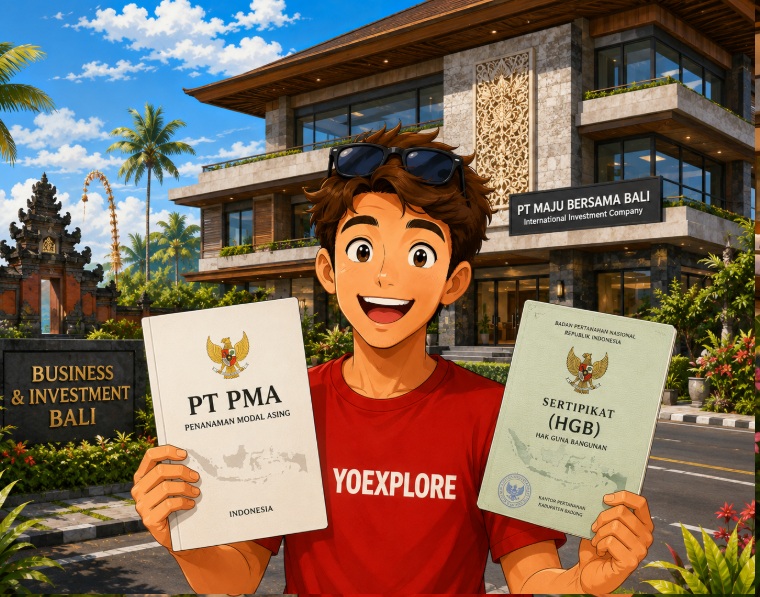
Path 3: PT PMA with HGB — If You’re Building a Business
Yoexplore- For Business
If you want to rent out villas, run a small boutique resort, develop multiple plots, or basically use property as a business, the company route is the only legal answer.
A PT PMA, or Perseroan Terbatas Penanaman Modal Asing, is a foreign-owned limited liability company registered in Indonesia. The company holds HGB, or Hak Guna Bangunan / Right to Build, title on the land, and you own the company. The HGB carries the same 80-year maximum tenure structure as Hak Pakai.
Here’s the genuinely useful update for 2026: BKPM Regulation 5/2025 cut the minimum paid-up capital for a PT PMA from IDR 10 billion to IDR 2.5 billion, around USD 150,000, and land and building value now count toward that investment threshold. For mid-tier nomads who used to think the PMA route was financially out of reach, that’s a real change.
What You Need
- IDR 2.5 billion in committed investment, which can include the property itself.
- A registered PT PMA, which takes around 4 to 8 weeks to set up.
- An Investor KITAS, which is automatically available to PT PMA shareholders/directors. This is a separate visa from the E33G remote worker visa.
- Ongoing compliance: quarterly LKPM investment activity reports to BKPM, annual corporate tax filings, and proper accounting.
What You Give Up
- Setup cost. Budget USD 3,000 to 5,000 for company formation, plus ongoing accounting and compliance fees.
- Tax exposure. Once you have a PT PMA, you have an Indonesian tax presence with everything that comes with it.
- Complexity. This is a real company, not a workaround. You have director liability, reporting obligations, and the cost of getting any of it wrong.
If you’re running villa rentals, the PMA is the only path that lets you do it legally, especially with the OSS-RBA compliance deadline that hit on 31 March 2026, requiring all listings on Airbnb, Booking.com and similar platforms to have a verified NIB business number and proper zoning approval.
Your Visa Is the Gatekeeper
Most articles bury this, but it deserves its own section. The visa you hold determines which ownership paths are even open to you.
- Tourist visa or B211A social visa: Leasehold only. No Hak Pakai, no PT PMA shareholding without the proper structure.
- E33G Remote Worker KITAS: Leasehold is straightforward. Hak Pakai is technically possible but practically inconsistent. You cannot use this visa to run a local business.
- Second Home Visa: Qualifies you for Hak Pakai. Doesn’t allow you to work locally, but you can hold property.
- Investor KITAS via PT PMA: Opens the full company-ownership route. The actual long-game answer for nomads building a real business in Bali.
- Indonesia Golden Visa: Available from around USD 155,000 investment, 5 to 10 year duration. Worth looking at if you’re committing serious capital.
If you’re on a tourist run-and-extend pattern, you’re locked into leasehold. That’s fine, just know that’s your ceiling until you upgrade your visa situation.
For most digital nomads testing whether Bali is their long-term base, leasehold is the right answer. Lower upfront cost, no visa entanglement, and a clean exit if you decide to leave.
The Compliance Wave You Need to Know About

Yoexplore- For Business tax
Bali in 2026 is not the wild west it was five years ago. A few things have changed materially:
- OSS/KKPR zoning verification is now mandatory before any land transaction can complete. Your notary has to check that your intended use matches the official zoning designation. Plots that were quietly sold to foreigners as “buildable” for years are now getting flagged.
- The March 31, 2026 OSS deadline required all rental platforms to verify NIB numbers, zoning, and building permits. Estimates suggest as many as 40 per cent of existing villa rentals were non-compliant before this deadline.
- The Dharma Dewata Immigration Task Force, inaugurated on 15 April 2026 in Denpasar, is actively patrolling Canggu, Seminyak, Kuta and other nomad hotspots looking for visa violations and unauthorised commercial activity. 165 deportations were recorded between January and mid-April 2026.
- The six-district construction moratorium on agricultural land — Tabanan, Jembrana, Buleleng, Bangli, Karangasem, and Klungkung — is in force as of February 2026. Badung, Gianyar, and Denpasar are exempt, but if you’re eyeing land up north or in the east, this matters.
None of this should scare you off. It just means doing the work properly is now the price of entry, not optional.
Where Nomads Are Actually Buying in 2026

image by Salt in our Hair
The Canggu corridor is still the biggest market by volume, but it’s also the most saturated. Land prices in central Canggu now run IDR 2 to 4 million per square metre, and you’re paying a premium for an area that’s lost a lot of its charm to construction noise and traffic.
The places where remote workers are actually picking up land in 2026:
- The Bukit Peninsula, including Ungasan, Balangan, and Pecatu: roughly 40 per cent cheaper than Canggu per square metre, with better surf access and a more spread-out vibe. Median land prices in Ungasan still sit accessibly compared to the cliff-front belt.
- Pererenan and Seseh: the spillover zones north of Canggu. Still has the cafe-and-coworking infrastructure, but quieter and cheaper.
- Sidemen and Amed in East Bali: for nomads who want jungle and ocean and don’t need to be in a co-working space every day. Significantly cheaper, with the trade-off that you’re an hour or more from anything.
- Ubud periphery, including Tegallalang and Payangan: for the wellness-aligned crowd. Watch out for green zone, or zona hijau, classifications on rice-field-view plots, since building permits won’t issue.
Once you’ve decided on a region, browsing current BaliPlots land listings is a useful way to see realistic price ranges per are. One are equals 100 square metres, the unit everyone uses here. It also helps you get a feel for what’s actually on the market versus what people claim in WhatsApp groups. You’ll quickly notice the gap between asking prices in the saturated zones and the emerging ones.
The Due Diligence Stuff Nobody Tells You
If you take one thing from this article, take this: the deal-breakers in Bali land are almost never the price. They’re the boring documentation issues. Specifically:
- Zoning. Is the plot zona kuning, meaning residential; zona pink, meaning tourism; or zona hijau, meaning green/agricultural? If it’s green, you can’t build accommodation on it, no matter what the seller says.
- Access road. Is the road to the plot a registered public road, or a private track that requires a separate easement agreement?
- Certificate status. Is the land certificate, whether SHM, HGB, or otherwise, fully clean, with no outstanding liens or Hak Tanggungan, and no boundary disputes?
- Heirs. If the seller inherited the land, have all the heirs signed off? Inherited-land disputes are one of the most common ways foreign buyers lose money.
- Subak land. If the land was historically part of the subak, the traditional rice irrigation cooperative, there can be water-rights and community obligations that transfer with the plot.
None of these are exotic problems. They’re routine, and they’re exactly what a proper notary and an independent lawyer are there to catch. Budget USD 1,500 to 3,000 for a proper due diligence process. Trying to save that money is the single most expensive mistake foreign buyers make in Bali.
So, Should You Actually Do This?
Here’s the honest answer: if you’ve been in Bali less than a year, probably not. Lease something nice, give it another six months, and make sure this is actually the life you want before locking up six figures in property.
If you’ve been here two years or more, you’ve got a stable remote income, and you can see yourself basing here for the foreseeable future, the case for buying gets a lot stronger. Leasehold is the easiest entry point. If you’re running a business or scaling up, the PT PMA route is where you’ll eventually end up anyway.
Just do it properly. Use a notary you found through someone you trust, not one the seller recommends. Verify zoning through OSS/KKPR before you commit. Hire an independent lawyer for the contract review. And accept that the cheapest path is almost always the most expensive one in the end.
Bali isn’t going anywhere. Take your time and get it right.